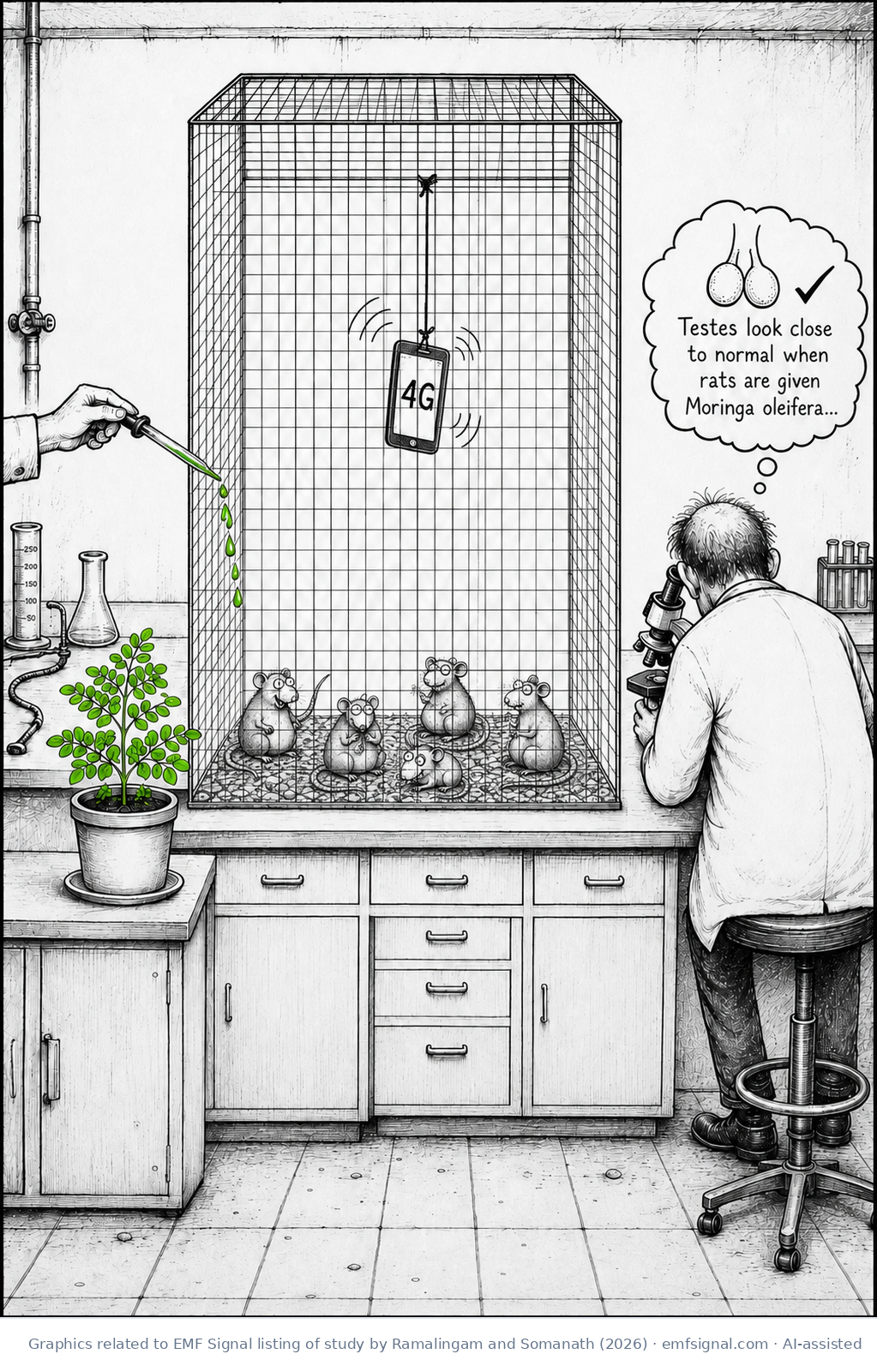
A study by Ramalingam and Somanath found that four weeks of daily 4G smartphone exposure in young Wistar rats significantly reduced Leydig-cell count, germinal-epithelium height and germ-cell numbers, meaning fewer testosterone-producing cells, thinner sperm-producing tissue and fewer developing sperm in the testes. Rats co-treated with a daily oral dose of ethanolic Moringa oleifera leaf extract (200 mg/kg), the drumstick tree eaten as a leafy vegetable in South Asia and Africa, ended near the non-exposed control group, pointing to Moringa as a potential protector against 4G radiation damage to the testes.
The study was small, with only 3 to 6 rats per group and a single time point.
"The infertility results from the detrimental effects of cell phone electromagnetic radiation (EMR) on spermatogenesis."
"The Leydig cell count, the height of germinal epithelium, and the number of germ cells were significantly decreased in the R1 group (P<0.04). However, those variables were shielded from the EMR by MOL extract in the R1+MOL group (P<0.04)."
"The ethanolic extract of MOL could safeguard the testis against the 4G cell phone EMR in young Wistar rats."
Exposure
"R1 group (n=6): exposed to 4G cell phone EMR for 96 minutes/day (4 minutes/every half an hour from 8 AM to 8 PM) for one month."
"MOL-1 group (n=6): received orally 200 mg of ethanol extract of MOL per kg body weight per day for one month."
"A common commercial Android smartphone brand that, according to the manufacturer, had a whole-body SAR value of 1.6 W/kg and a peak power density of 2 W/kg. The average power density of the phones, determined by the Cornet Electrosmog radio frequency (RF) meter using the electromagnetic field values of the rat cage's interior, was 187.9 mW/m2."
"In this analysis, an insignificant reduction in the count of spermatogonia can be due to exposure to short-term EMR at a low SAR value."
Moringa leaf mitigates 4G cell phone radiation-induced alterations in testicular histomorphometry and spermatogenesis during sexual maturation in Wistar rats
Ramalingam S, Somanath D (2026) Anatomy & Cell Biology Journal Level 0ⓘ