A team from Korea's ETRI, Télécom Paris, and Aristotle University of Thessaloniki measured real-world 3G/4G/5G downlink fields and phone transmit powers across urban and rural South Korea, then combined them into brain SAR using anatomically realistic child and adult head models.
Whole-brain-averaged SAR in the urban site ran 6.2 dB higher than rural for the child model and 5.7 dB higher for the adult, dwarfing the child-versus-adult gap of 0.8 to 1.3 dB. In most scenarios, downlink from base-station infrastructure matched or exceeded exposure from the phone in hand, which the authors say challenges the assumption that handsets are the dominant source of brain RF-EMF exposure. All values sat well below ICNIRP and IEEE public limits.
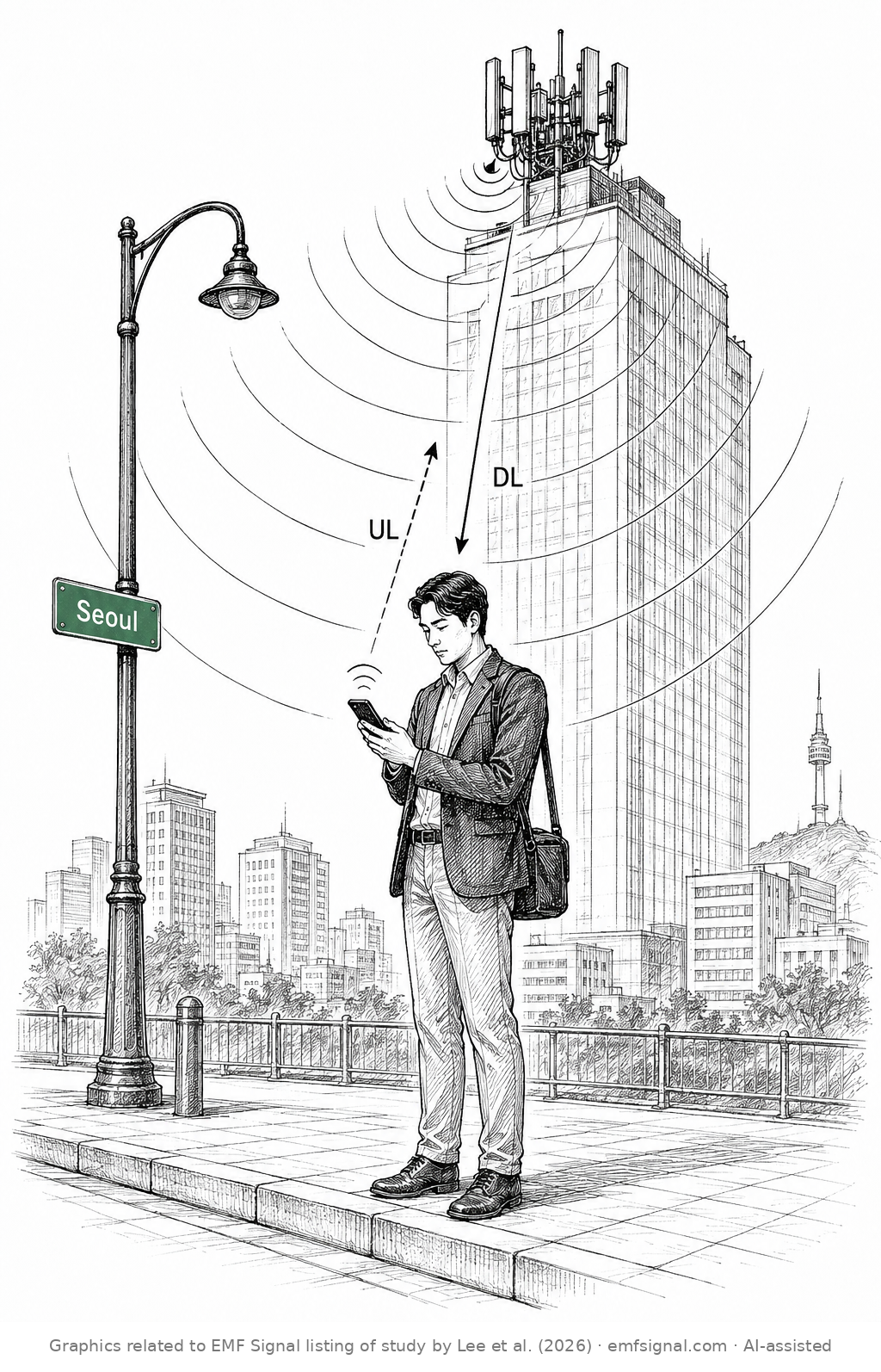
"the whole-brain-averaged SAR in Urban 1 was 6.2 and 5.7 dB higher than that in Rural for the child and adult, respectively. These results indicate that environmental factors, rather than age, are the dominant drivers of SAR variation"
"many cases showed that brain SAR from DL EMF exposure was comparable to or exceeded that from UL Tx power. These findings suggest that the long-standing perception that mobile phones are the primary source of RF-EMF exposure to the brain may no longer fully reflect modern mobile-network environments."
Real-World Assessment of RF-EMF Exposure From 3G, 4G, and 5G Mobile Networks Across Different Urbanization Levels
Lee AK, Jeon S, Hong SE, Wang S, Wiart J, Samaras T, Moon JI (2026) IEEE Access Journal Level 1ⓘ